
Early Life and Family
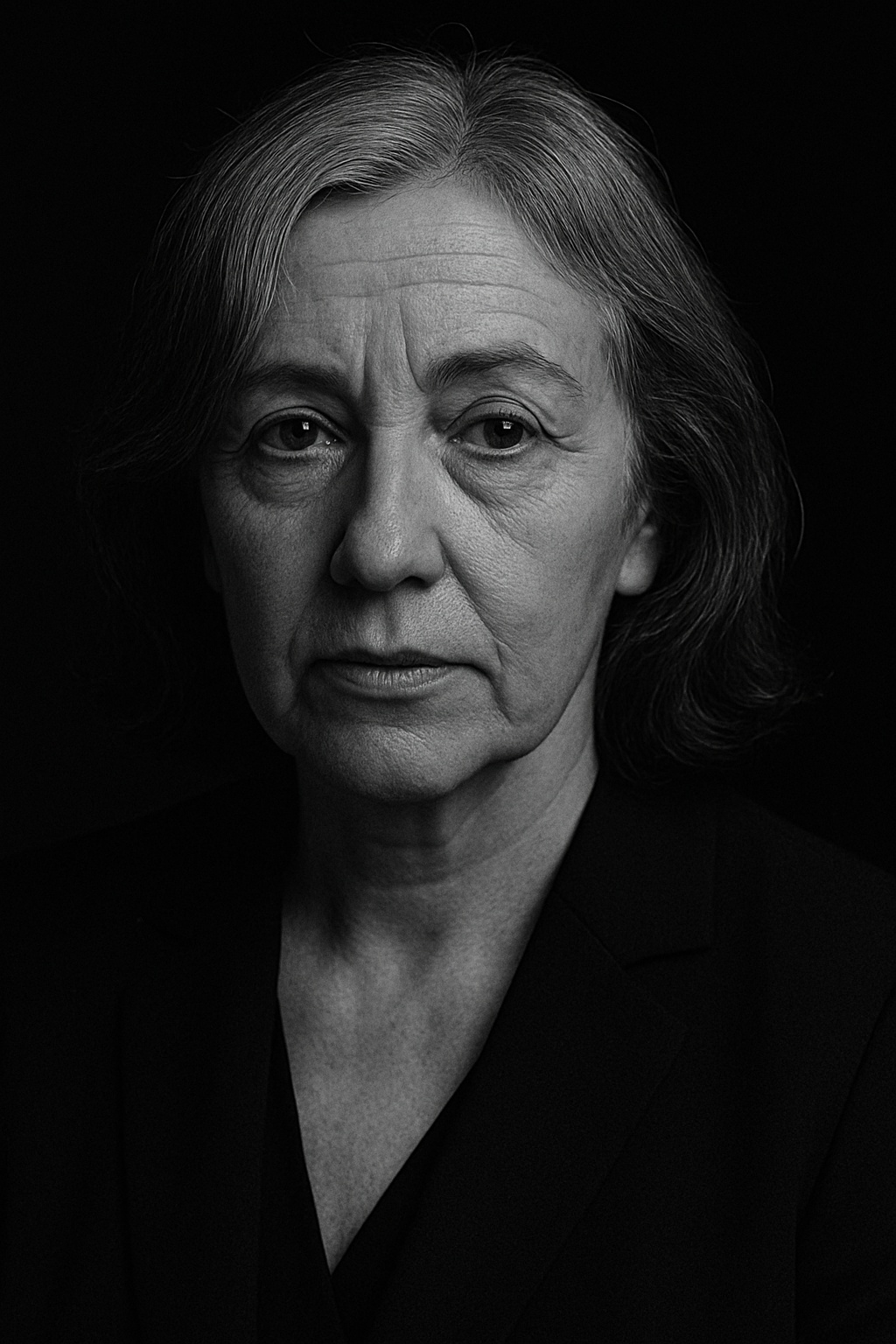
Eleanor Marie Castellanos was born in early spring of 1958 in Tucson, Arizona, to Tomás Rafael Castellanos and Ruth Ellen (Morrison) Castellanos. Her father, Tomás, was a first-generation Mexican-American who built a successful business selling irrigation equipment throughout southern Arizona. A practical man with a head for numbers, he taught Eleanor to fix carburetors and read water tables.
Her mother, Ruth Ellen Morrison, came from a family of Pennsylvania Presbyterians who had moved west in the 1930s. A classically trained pianist, she played evening performances at the Fox Theatre downtown, filling their modest home with the sounds of Chopin, Debussy, and Gershwin. Ruth offered a counterbalance to Tomás's pragmatism—she taught Eleanor nocturnes on their upright piano and told her that beauty was its own form of intelligence.
Eleanor grew up with one younger sister, Carmen Victoria Castellanos (born 1962), who would later become a high school mathematics teacher in Phoenix. The two sisters shared a bedroom in their childhood home, where Eleanor would explain constellations through their window while Carmen practiced multiplication tables. Their childhood took shape in the long horizontals of the Sonoran Desert, where saguaros stood like silent witnesses and the night sky was thick with stars.
When Eleanor was twelve, she borrowed a secondhand telescope from a neighbor and spent a summer mapping the craters of the Moon onto graph paper. Her mother left books on her nightstand: Sagan's Cosmos, Ferris's Coming of Age in the Milky Way. Eleanor read them by flashlight and felt, for the first time, that the universe was asking her a question.
Education and Early Career
Castellanos attended the University of Arizona in 1976, one of only a handful of women in the physics program. The department was housed in a brutalist concrete building that trapped heat like an oven, and she remembers the faint smell of solder and old chalkboards. She excelled in quantum mechanics but was drawn irresistibly to astronomy—to the idea that light could be a messenger carrying news from distances the mind could barely hold.
She completed her undergraduate degree in 1980 and stayed at Arizona for her doctorate, joining the group studying planetary atmospheres under Dr. William Hubbard. Her dissertation focused on the methane absorption bands in Neptune's atmosphere, work that required endless nights at Kitt Peak National Observatory, adjusting spectrographs and drinking coffee gone cold in styrofoam cups.
She defended in 1986, the same year Voyager 2 flew past Uranus. The timing felt auspicious. Her thesis advisor told her she had "a mind built for patience and precision—the twin virtues of spectroscopy."
Contributions to Exoplanet Atmospheres
In 1987, Castellanos took a postdoctoral position at Caltech, where she began working on techniques to detect atmospheric composition in planets orbiting other stars. This was years before the first confirmed exoplanet—the field was speculative, almost heretical. The work was called "astronomy without objects."
But Castellanos was undeterred. She developed mathematical models predicting the spectral signatures of water vapor, carbon dioxide, and methane in exoplanet atmospheres, publishing a series of papers between 1989 and 1995 that contributed to the emerging framework. Her 1994 paper, "Biosignature Gases in the Atmospheres of Terrestrial Exoplanets," explored how detecting oxygen and methane simultaneously might indicate biological processes—a concept that would be refined and expanded by later researchers.
When the first exoplanet orbiting a Sun-like star was confirmed in 1995, Castellanos was ready. By 1999, she had joined a collaborative team using the Hubble Space Telescope to study the atmosphere of HD 209458b, a "hot Jupiter" transiting its parent star. Her spectroscopic analysis contributed to the detection of sodium in its atmosphere—part of the first chemical identification in an exoplanet.
She contributed to the science team for the James Webb Space Telescope in 2004, working on observation protocols for exoplanet atmospheric characterization. She was meticulous to the point of obsession, prone to recalculating uncertainties at three in the morning and quoting Neruda in team meetings.
Personal Life
Castellanos married David Michael Castellanos, a civil engineer, in 1988. They met at a lecture on water management in the Southwest—she was there studying atmospheric circulation; he was designing aqueducts. Their marriage was marked by long absences and competing devotions. They had one daughter, Sofia Elena Castellanos, born in 1992. Sofia remembers her mother as both fiercely present and perpetually elsewhere, mentally tracing spectral lines during dinner. Sofia would go on to study environmental science at UC Berkeley, drawn to questions of climate and planetary boundaries—a path her mother quietly encouraged.
The marriage dissolved in 2003. Eleanor kept the house in Pasadena with its view of the San Gabriel Mountains and the small office where she worked at a standing desk covered in Post-it notes and star charts. She was solitary but not lonely, content with silence and the company of ideas.
She maintained close ties with her sister Carmen, who would visit during summer breaks with her own children, filling Eleanor's quiet house with the chaos of teenage energy. Their father Tomás passed away in 2008; their mother Ruth in 2015. Eleanor delivered the eulogy at her mother's funeral, speaking about the gift of being taught that wonder was not frivolous but essential.
She never stopped working. Even after formal retirement in 2020, she mentored graduate students and reviewed papers, her annotations famously thorough and occasionally devastating. She once wrote in a rejection: "Your error bars are not uncertainty—they are hope pretending to be mathematics."
In a rare public talk she said, "To study exoplanets is to practice a kind of faith. We are learning the alphabet of worlds we will never visit, composing letters to civilizations that may not exist. But the act of looking—that is everything."
Legacy
Dr. Eleanor Castellanos's work contributed meaningfully to the development of exoplanet atmospheric science during its formative years. Her theoretical models and spectroscopic techniques informed later observational strategies, and her papers remain cited in the field. She trained a generation of graduate students who went on to careers in planetary science and astrobiology.
She has quietly funded scholarships for first-generation college students in Arizona and New Mexico, refusing recognition and insisting the money carry no name but "for those who look up." She remains a fierce advocate for dark-sky preservation, writing op-eds about light pollution with the same precision she once brought to spectroscopy.
In retirement, she has returned to Tucson, to a small house near Saguaro National Park where the stars still crowd the sky like a promise. She rises before dawn to write and watch the desert light change, convinced that the longest journey is not into space but into the sustained attention required to see what is already there.